
Recently, Data Roadmaps was engaged to support a Data Organization that was struggling to make progress with its IT Organization. Business Groups were frustrated by the pace of change. Important issues had remained unresolved for years. Requirements existed, yet progress remained elusive.
At first glance, it appeared to be a technology problem. It wasn’t.
The underlying challenge was the absence of a shared framework for translating business needs into actionable outcomes. Business Groups struggled to articulate their needs in a way that could be implemented.
Without a common language and structured collaboration model, the Data Organization struggled to effectively lead conversations with Business Groups and IT.
The Data Organization found itself reacting to requests rather than leading conversations. IT was left trying to interpret ambiguity. The result was predictable: Misalignment. Frustration. Slow progress.
Data Roadmaps approached the challenge through analytics translation. Rather than starting with technology, we started by creating clarity.
We introduced a structured framework that connected business questions to specific analytical use cases. This established a common language between Business Groups, the Data Organization, and IT.
From there, we introduced practical approaches for requirements definition, user acceptance testing, delivery execution, process visualization, use-case prioritization, gap analysis, and roadmap development. These frameworks were intended to help stakeholders move from abstract ideas and pain points toward specific, actionable outcomes.
As ambiguity gave way to clarity, cross-functional teams shifted from debating requirements to delivering outcomes.
The first result was a successful delivery milestone that helped establish a more productive working relationship between the Data Organization and IT.
The more significant result came afterward.
What began as a collection of pain points, frustrations, and wish lists evolved into a collaborative effort to define future-state objectives, prioritize use cases, identify gaps, and establish a roadmap for execution.
At that point, it would have been easy to continue refining requirements and addressing issues one at a time. Instead, a different question emerged: What should come next?
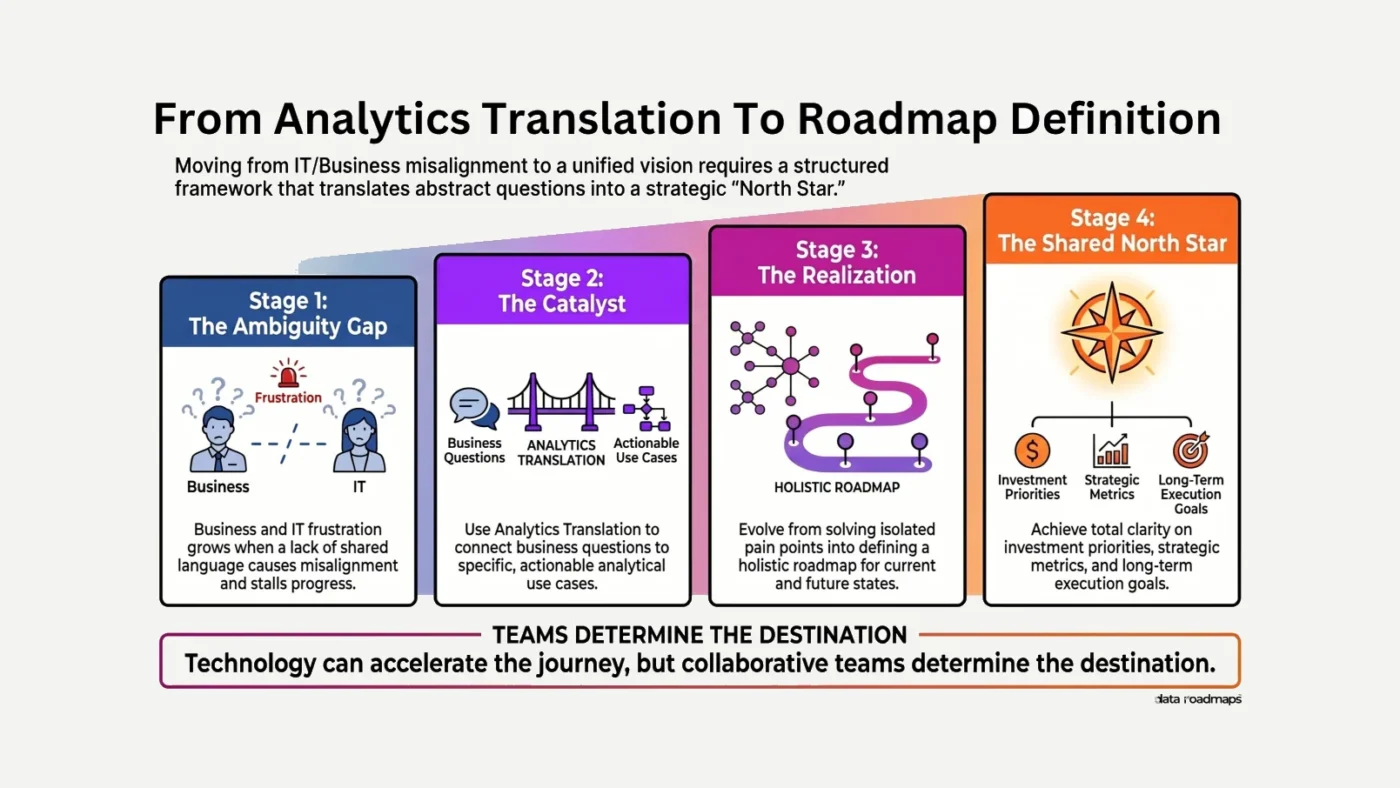
The backlog contained pain points, frustrations, enhancement requests, and future ideas. While analytics translation helped clarify individual requirements, it did not provide a clear answer to where the organization should invest its time, funding, and attention over the next several years.
That realization created a pivot. The conversation shifted from “What does this requirement mean?” to “What outcomes are we trying to achieve?”
What followed was a collaborative effort to define future-state objectives, prioritize use cases, identify gaps, and establish a roadmap for execution.
Within weeks, leadership was able to more clearly articulate:
- Where they were?
- Where they wanted to go?
- What should be prioritized?
- What investments were required?
- How success would be measured?
With the roadmap serving as a shared north star, the team was better positioned to align priorities, justify investments, and guide future execution.
The roadmap was the output. The capability to use it as a shared north star for turning priorities into outcomes is the opportunity. This experience reinforced an important lesson. “Analytics translation can help organizations solve today’s problems. Roadmap definition helps organizations decide which problems are worth solving next.”
Whether the initiative involves AI, data, analytics, cloud, or business transformation, progress begins when business, data, and technology teams align around shared outcomes, clear responsibilities, and a roadmap for execution.
Technology can accelerate the journey. Collaborative teams determine the destination.